Frequently Asked Questions
Home hardening, defensible space, wildfire defense systems, insurance, and everything else you need to know about protecting your Bay Area property.
Quick Answers
Fast, factual answers to the questions people ask most about wildfire sprinklers, cost, and defensible space
Yes. In the 2007 Ham Lake Fire, all 188 homes protected by exterior sprinklers, defensible space, and home hardening survived, while more than 100 neighboring homes without them burned. Exterior sprinklers pre-wet the roof, eaves, and the ground around the house, so wind-driven embers land on wet material instead of dry fuel and wash away before they ignite. They do not replace defensible space or home hardening. They add an active layer on top of them.
A wildfire sprinkler system in the Bay Area runs $33,000 to $63,000 installed, about $11 to $21 per square foot of covered area. The price depends on how much of the home you cover, roof only, roof plus eaves, or the full perimeter with optional Class A foam, along with your water supply and lot terrain. Every FireRoofs system includes a smart controller and carrier-ready insurance documentation. See our full roof sprinkler system cost breakdown for pricing by system type and home size.
The 3 times rule comes from NFPA 13, the standard for interior fire sprinklers. It says a sprinkler head should sit at least three times the width of a nearby obstruction away from it, so the spray is not blocked. A beam 4 inches wide, for example, calls for the head to be at least 12 inches away. It is an indoor design rule and does not apply to exterior wildfire sprinklers, which are placed along the roofline, eaves, and perimeter to wet the outside of the home.
California defensible space has no Zone 3. State law (PRC 4291) defines Zone 0 (0 to 5 feet), Zone 1 (5 to 30 feet), and Zone 2 (30 to 100 feet). People sometimes say Zone 3 loosely for the area past 100 feet or for wider community fuel breaks, but it is not part of the official standard. If your goal is protecting the structure, the highest-impact area is Zone 0, the first 5 feet.
They can help. California Insurance Code Regulation 2644.9 requires insurers to account for wildfire mitigation when they set premiums, and a documented exterior sprinkler system is one of the strongest active measures a homeowner can show. It does not guarantee a fixed discount, because each carrier weighs mitigation differently, but it strengthens your file and can help at renewal or with getting off the FAIR Plan. FireRoofs provides carrier-ready documentation with every install.
FireRoofs designs and coordinates automated exterior wildfire sprinkler systems for homes and estates across the San Francisco Bay Area, where all work is performed by licensed and insured contractors. We serve high fire-risk communities including Saratoga, Los Gatos, Monte Sereno, Woodside, Portola Valley, Los Altos Hills, Scotts Valley, and the surrounding wildland-urban interface. Each system is designed on site for the property, and every system includes a smart controller and carrier-ready insurance documentation. Call 831-705-0888 to schedule an assessment.
Home Hardening
Vents, siding, decks, fences, and what your insurance carrier looks for
Home hardening means upgrading the exterior materials and construction details of your home to resist wildfire ignition. That includes your roof, vents, eaves, siding, windows, decks, fences, and anything else attached to the structure. California PRC 4291 and Insurance Commissioner Regulation 2644.9 define specific categories. Most homes ignite not from direct flames but from wind-blown embers landing on vulnerable surfaces. Home hardening reduces those ignition points.
For existing homes in a State Responsibility Area or Very High Fire Hazard Severity Zone, the primary requirement is defensible space compliance under PRC 4291, including the newer Zone 0 (0 to 5 feet of noncombustible space around the structure). Existing homes are not currently required to retrofit to the latest Chapter 7A building standards, which apply to new construction. However, any time you replace a roof, re-side, or replace windows or vents, the new materials must meet current fire-resistant standards. Think of it as a trigger: once you touch it, you bring it up to code.
Insurance carriers evaluate mitigation under Regulation 2644.9, which lists specific categories: Class A fire-rated roof, enclosed eaves, ember-resistant vents, tempered or multi-pane windows, fire-resistant siding, noncombustible decking within Zone 0, and noncombustible fencing within 5 feet of the home. None of these retrofits are mandated for existing homes, but each one your carrier can verify and document strengthens your underwriting file. The more categories you can check off with supporting documentation, the better position you are in when your broker goes to market.
Standard attic and soffit vents are one of the most common ember entry points during a wildfire. Embers pass through standard mesh, land on insulation or wood framing, and ignite your attic from the inside. Ember-resistant vents (1/8-inch mesh or intumescent models that swell shut under heat) block that pathway. Replacing your vents is one of the most cost-effective home hardening upgrades you can do, and insurance carriers specifically look for it under Regulation 2644.9.
Combustible siding (wood shingles, untreated wood panels) can ignite from radiant heat or ember accumulation. Fiber cement, stucco, and metal siding are fire-resistant and recognized by insurance carriers as mitigation measures. If your home has wood siding, replacing it with fire-resistant material is a significant upgrade. If your siding is already stucco or fiber cement, you are in good shape on that category. The key is having documentation that proves the material and installation date.
Any deck, porch, or fence that physically attaches to your home acts as a fuel bridge. A wood fence connecting to the house can carry fire directly to the structure. A combustible deck under your living space is a major vulnerability. California code requires noncombustible materials within Zone 0 (0 to 5 feet) for new construction, and insurance carriers look at decking and fencing as specific mitigation categories. If you have a wood deck or wood fence that connects to your home, replacing or detaching it from the structure is one of the highest-impact upgrades.
Home hardening is passive. You upgrade materials so they resist ignition on their own. A wildfire defense system is active. It detects fire and responds by wetting your property with water and optional foam. The two work together. A hardened home with fire-resistant vents, Class A roof, and enclosed eaves is far less likely to ignite. An active defense system saturating those same surfaces with water during an event adds another layer. Neither replaces the other. The strongest position is both.
Defensible Space
Zones 0, 1, and 2, maintenance, and PRC 4291 requirements
Defensible space is the buffer zone you create between your home and the surrounding vegetation, landscaping, and combustible materials. California PRC 4291 requires property owners in fire hazard zones to maintain 100 feet of defensible space (or to the property line, whichever is less) around all structures. It is divided into three zones, each with different requirements for vegetation management and fuel reduction.
Zone 0 is 0 to 5 feet from the structure. This is the ember-resistant zone. No combustible materials, no vegetation (other than carefully maintained fire-resistant plants), no mulch, no firewood, no patio furniture that can ignite. Zone 1 is 5 to 30 feet. This is the lean, clean, green zone. Trees spaced at least 10 feet apart (crown to crown), branches trimmed 6 to 10 feet from the ground, no ladder fuels connecting ground cover to tree canopy. Zone 2 is 30 to 100 feet. This is the reduced fuel zone. Tree spacing increases, dead vegetation is removed, and overall fuel load is reduced to slow fire spread and reduce intensity.
Yes. PRC 4291 requires all property owners in a State Responsibility Area or local Very High Fire Hazard Severity Zone to maintain defensible space. CAL FIRE inspectors can and do issue violations. Effective 2024, Zone 0 (the noncombustible zone within 5 feet of the structure) is now part of the requirement.
Zone 0 covers the first 5 feet around your home, measured from the exterior wall. Within that zone: no combustible fencing, no wood mulch, no bark, no dried leaves or debris, no firewood storage, no combustible patio covers or shade structures. Hard surfaces like gravel, pavers, concrete, or bare soil are preferred. Fire-resistant plants are allowed if maintained and irrigated. The goal is a noncombustible perimeter so embers that land near your home have nothing to ignite.
Zone 1 (5 to 30 feet) allows trees and plants, but spacing and maintenance matter. Trees should be spaced 10 feet apart (crown to crown) and limbed up 6 to 10 feet from the ground to eliminate ladder fuels. Shrubs should not be planted directly under trees. Dead branches, leaves, and debris must be removed regularly. Use fire-resistant species native to California when possible. Your local Fire Safe Council or CAL FIRE office can provide approved plant lists for your area.
At minimum, before fire season each year. Most Bay Area homeowners clear and maintain defensible space in late spring. In practice, maintaining Zone 0 and Zone 1 is ongoing: remove dead vegetation after wind events, keep gutters clear of debris, trim back new growth that encroaches into setback distances. Think of defensible space as landscaping maintenance with fire safety as the priority.
They work together. Defensible space reduces the fuel around your home so fire cannot easily reach the structure. Home hardening makes the structure itself resistant to ignition if embers or radiant heat do reach it. A home with perfect defensible space but a wood shake roof is still vulnerable. A fully hardened home surrounded by dense brush is still at risk. The strongest protection comes from both: defensible space to slow and reduce the fire, hardened materials to resist what gets through, and an active defense system on top.
System and Detection
How the defense system works, threat levels, and automated activation
FireRoofs designs and coordinates automated exterior wildfire defense systems for luxury homes in Bay Area WUI communities. The system combines two independent detection layers (regional satellite data and on-property environmental cameras) with three-stage automated sprinkler response. When a threat is detected, the system activates on its own, wets your roof, eaves, and perimeter with water and optional Class A firefighting foam (100% biodegradable, non-toxic to plants, pets, and wildlife, rinses off through the sprinklers), and switches water sources automatically if municipal pressure drops. It runs whether you are home or not.
No. Interior fire sprinklers are heat-activated and designed to suppress fire that has already started inside your home. FireRoofs systems are exterior. They protect the outside of your home, your roof, eaves, gutters, and surrounding property from the ember storm and radiant heat that arrives before flames do. The two systems address completely different threat scenarios and can coexist on the same property.
No. Garden and irrigation systems are designed for calm conditions at low flow rates. A wildfire defense system has to perform in heat, wind, ash, and extended run times. FireRoofs uses commercial-grade industrial sprinklers, industrial fittings, industrial roof mounts, and contractor-grade copper piping, all specified for permanent outdoor installation and engineered to hold up under real fire conditions. Coverage is designed with 100 percent overlap between heads to account for high wind. An irrigation sprinkler will evaporate or blow away. A properly engineered system keeps surfaces continuously wet long enough to matter.
The system uses two independent detection layers working together. Regional satellite data monitors active fire within a 5-mile radius of your property. On-property cameras with intelligent fire detection continuously scan the surrounding landscape for wildfire threats. The system escalates automatically through multiple threat levels based on fire proximity and confirmed threats on the ground.
No. The system is fully automated and activates based on fire proximity, whether you are home or away. When satellite data detects a distant fire, the system alerts you with a push notification and a cancellation window. As the threat moves closer, the system escalates automatically through higher threat levels. At no point do you need to be present or take any action for the system to defend your property.
The system uses three threat tiers that escalate automatically based on fire proximity. At the earliest stage, you receive a push notification with a cancel window. As the threat moves closer, the system activates automatically. At the highest level, the system triggers immediate full activation. A physical emergency button on the smart controller enclosure allows manual activation at any time.
Our on-property cameras are specifically designed to detect wildfire threats at close range, including structure fires on adjacent properties. When a neighboring home ignites, the camera detection layer identifies the threat and escalates the system response immediately. Eave sprinklers, roof sprinklers, and optional Class A foam work together to create a continuous moisture barrier on your home's most vulnerable surfaces.
The system requires electrical power to operate. FireRoofs strongly recommends a backup generator as the primary power solution. A generator delivers the sustained wattage needed to run backup water pumps, booster pumps, and the satellite communication link simultaneously for hours. Battery systems such as Tesla Powerwall can keep the controller and cameras running but may not sustain the higher electrical loads required for water pumping.
Yes. The FireRoofs app gives you full remote control of your system from anywhere. You can see real-time threat levels, receive push notifications when the system detects a threat, manually activate or cancel individual zones, monitor water pressure and backup supply status, and review system health and detection history.
No. Defensible space is the foundation. FireRoofs enhances what you have already done. It does not replace the requirement to do it. Cleared vegetation, fire-resistant materials, and ember-resistant vents reduce ignition risk passively. The FireRoofs system adds active defense on top of that foundation. The combination is significantly more effective than either approach alone.
Water and Coverage
Water supply, pool integration, sprinkler zones, and performance
Roof sprinklers cover the entire roof surface, gutters, and the immediate area around the home to prevent combustion of nearby items. Eave sprinklers wet the eaves, vents, walls, and windows to protect against ember intrusion and radiant heat. Perimeter sprinklers, if installed, help prevent ember ignition of hillsides or surrounding vegetation approaching the house. Coverage is engineered for your specific lot, not applied from a template.
Yes. Roof sprinkler systems pre-wet the roof and surrounding surfaces, dramatically reducing ignition risk from radiant heat and airborne threats. In the 2007 Ham Lake Fire, 100% of homes equipped with exterior sprinklers, combined with defensible space and home hardening, survived while neighboring unprotected structures were lost. See the full evidence.
Yes, and a pool is one of the best backup sources available. Pool integration requires a dedicated pump system and filtration to protect sprinkler components. We design and install the full pool integration as part of the system build. If pool water is being used, a backup generator is strongly recommended to power the pool pump during grid outages.
Your water pressure is tested during the property evaluation. We measure your actual static and dynamic pressure and design the system around what your supply can sustain. If pressure is below the required threshold, a booster pump can be added as part of the installation.
The system can operate on municipal water supply alone. We assess municipal pressure and flow capacity during your property evaluation. If your municipal supply is insufficient or unreliable under fire conditions, we design a solution (booster pump, storage tank, or both) that ensures the system has the water it needs.
Wind can affect water distribution. To account for this, every FireRoofs system is designed with overlap between sprinkler heads so that coverage is maintained even when wind shifts spray direction. Sprinkler head placement and type are selected based on the specific wind exposure of your property.
Yes. FireRoofs systems are designed with copper pipe throughout and custom zone layouts that account for slope, exposure, and terrain. Hillside properties in communities like Los Gatos, Saratoga, and the Santa Cruz Mountains are among the most common installations.
Installation and Cost
What to expect, timelines, piping, aesthetics, and pricing
Yes. FireRoofs systems are designed for all roof types: tile, metal, composition shingle, wood shake, and flat roofs. Every system is designed for the specific geometry and material of your roof.
Both. The system is designed for retrofit installation on existing homes as well as new construction. In all cases, piping is exposed on the exterior of the home. Our standard installation includes paint matching the copper piping that runs along the walls. Paint matching piping on the eaves or roof is available as an added cost.
We walk your entire property and assess roof type and pitch, vegetation zones and ember exposure points, water supply and pressure, lot topography and wind exposure, number of structures requiring coverage, and access points for installation. We then design a system specific to your property and provide a full scope with investment range. No commitment required.
We take aesthetics seriously on every installation. All piping is exposed on the exterior. Our standard installation includes paint matching the copper piping that runs along the walls of your home. Paint matching piping on the eaves or roof is available as an added cost. Sprinkler heads are low-profile and positioned to be as discreet as possible.
FireRoofs designs and coordinates each system with vetted, licensed and insured partner contractors. Timelines are property-specific. Every system is commissioned and tested before handoff, including homeowner training on the app.
System cost depends on property size, number of zones, roof pitch and complexity, water source configuration, and whether foam injection is included. Every system is designed for the specific property. The evaluation is free and we provide a full system design with investment range before any commitment is required.
We use commercial-grade industrial sprinklers, industrial fittings, and industrial roof mounts throughout every installation. All piping is contractor-grade copper and exposed on the exterior of the home. Everything specified and installed is built for permanent outdoor use and engineered to perform under real fire conditions.
DIY and low-cost kits use irrigation-grade components not designed for wildfire conditions. They typically have no automation, no detection, no foam capability, and no backup water switching. They require you to be home to activate them, exactly when you should be evacuating. A FireRoofs system is engineered from the ground up for wildfire conditions: commercial-grade hardware, dual wildfire detection, three-level automated activation, optional Class A foam, and automatic backup water switching. For a side-by-side look at pricing, see our guide to DIY roof sprinkler system cost vs professional installation.
Insurance and Compliance
Discounts, Regulation 2644.9, FAIR Plan, SB 429, and documentation
Many surplus lines carriers and some admitted carriers recognize documented wildfire mitigation systems. After installation we provide a complete evidence packet (engineering specifications, component certifications, activation testing records, and detection coverage maps) formatted for underwriting review. California's Safer from Wildfires framework also requires participating insurers to offer discounts for qualifying mitigation measures.
California Insurance Commissioner Regulation 2644.9 requires participating carriers to offer rate reductions for verified wildfire mitigation. The regulation defines specific categories: roof class, vent type, eave enclosure, window glazing, siding material, decking, and fencing. Each verified category strengthens your position. The key word is "verified." Carriers need documentation, not just the work itself.
Absolutely. Defensible space compliance is one of the first things insurance carriers and underwriters evaluate. Under Regulation 2644.9, documented defensible space is a recognized mitigation category. A property with verified 100-foot defensible space, documented Zone 0 compliance, and photographic evidence is significantly more attractive to carriers than a property with no documentation.
We photograph every upgrade before, during, and after installation. Each mitigation category (roof, vents, eaves, siding, windows, decking, fencing) is documented with material specifications, manufacturer compliance data, and installation photos. The full package is formatted for your broker to present during underwriting review.
A documented, professionally installed wildfire defense system adds tangible value in two ways. First, it reduces the cost and difficulty of obtaining and maintaining insurance coverage, which directly affects a property's insurability and marketability in fire zones. Second, buyers in high-risk areas increasingly view a functioning defense system as a meaningful asset.
Exterior wildfire sprinkler systems like FireRoofs are voluntary upgrades, not code-mandated. California building codes require interior fire sprinklers in new residential construction, but exterior wildfire defense is a separate category that homeowners choose to add for protection beyond code minimums.
SB 429 establishes the Wildfire Public Catastrophe Model to bring transparency to how wildfire risk is assessed in insurance. It took effect January 1, 2026.
FireRoofs Services
What we do, how we work, warranty, maintenance, and service area
Yes. FireRoofs coordinates and manages home hardening projects. All physical construction work is performed and overseen by licensed and insured contractors. We handle the evaluation, scoping, contractor coordination, and most importantly, the documentation. Every upgrade is photographed, recorded, and packaged into an evidence file formatted for insurance underwriting review. For hardening-only projects, professional risk assessments, defensible space and vegetation work, or siding and roofing replacement, we refer homeowners to our partner network.
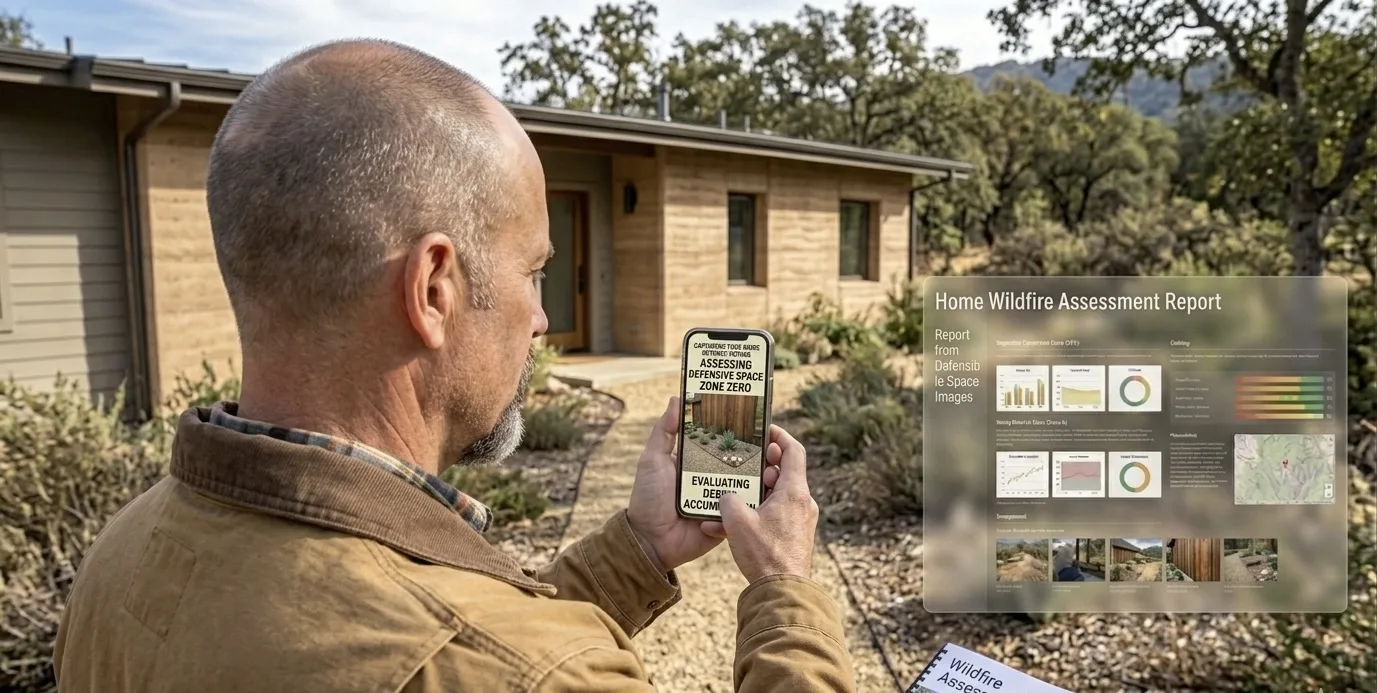
Yes. FireRoofs evaluates and coordinates defensible space work as part of the property assessment. All vegetation management and landscape construction work is performed and overseen by a licensed California general contractor. We document the work for insurance purposes, including photos of each zone, vegetation clearance measurements, and compliance status.
No. FireRoofs is not a general contractor. A licensed California general contractor performs and oversees all construction work on your property. FireRoofs manages the project scope, coordinates the work, and provides the documentation and insurance evidence packaging. You get licensed, insured construction work with a layer of wildfire-specific project management and carrier-ready documentation on top.
FireRoofs provides an 18-month workmanship and installation warranty covering labor, technology, and the full installed system. All FireRoofs clients receive a 20 percent discount on any future system upgrades or technology additions within the first three years from installation.
The system is fully transferable to the new owner and conveys with the property. When ownership transfers, we schedule a one-hour on-site consultation with the new homeowner at no charge, walking them through the system, the app, manual activation and deactivation, maintenance procedures, and what to expect during a fire event.
We offer an optional annual maintenance plan covering system inspection and testing, sprinkler head cleaning, sensor and camera checks, control panel diagnostics, foam concentrate replacement if applicable, and a pre-fire-season readiness check. You can also maintain the system yourself using the procedures covered during your system walkthrough.
FireRoofs serves communities across the Bay Area and Santa Cruz Mountains, including Saratoga, Los Gatos, Woodside, Portola Valley, Los Altos Hills, Scotts Valley, Danville, Morgan Hill, and more. 50+ years of local construction and irrigation expertise. Every system designed for the specific terrain.
Yes. Many homeowners handle Zone 1 and Zone 2 vegetation management themselves. Clearing brush, trimming trees, removing dead material, and maintaining spacing are all things you can do. The value FireRoofs adds is the professional evaluation of what needs to be done, coordination of larger projects (tree removal, grading, landscape redesign), and the documentation that makes it count with your insurance carrier.
Foam and Safety
Class A foam, safety, cleanup, and storage
The default is water from your primary supply: municipal connection, pool, or storage tank. When the system escalates to its highest threat level, Class A firefighting foam can be added to the water stream if your system includes the optional foam injection module. Class A foam is the same formulation used by wildland fire agencies. It is biodegradable, non-toxic to plants and pets, and washes off completely with a standard rinse cycle after the threat clears.
Yes. Class A foam contains no hazardous materials, is non-corrosive, non-toxic, and readily biodegradable. It has no chemicals listed on California's Proposition 65 list of hazardous materials. It is the same formulation used by professional wildland firefighters and is safe for plants, pets, and landscaping.
No. Class A foam is non-corrosive and non-damaging to roofing materials, siding, paint, or exterior finishes. It is specifically formulated for use on structures and has been in widespread use by fire agencies for decades. Foam washes away cleanly and leaves no staining or residue.
After the threat clears, the system enters rinse mode. Class A foam is fully biodegradable and rinses away cleanly with a standard water cycle. No hazmat procedure is required. Landscaping may show temporary flattening from water pressure but recovers normally.
Still Have Questions? Start Here.
The quickest way to understand your wildfire situation is to see your property from above. Our satellite pre-assessment shows your fire zone, roof condition, and vegetation clearance. No signup, no phone call.
- Two-minute satellite check of your address
- See your fire zone and nearby vegetation
- Decide if you want a full assessment afterward
Takes about a minute. No account needed.
Still have questions?
Send us a message and we'll get back to you within 24 hours.