Firewise Communities in California.
How neighborhoods earn NFPA recognition, what it means for your insurance, and the five steps to get your community started.
All work is performed by licensed and insured contractors.
How It Works
Form a Committee
Minimum 8 dwelling units per site
Risk Assessment
Community-wide wildfire risk evaluation
3-Year Action Plan
Measurable goals with CAL FIRE template
Earn Recognition
NFPA Firewise USA certification
70+
Marin County Sites
5-20%
Insurance Discounts
What Is a Firewise Community?
A Firewise community is a neighborhood that has earned official recognition through the NFPA Firewise USA program for taking measurable steps to reduce wildfire risk. The program is administered by the National Fire Protection Association and supported in California by CAL FIRE. To earn recognition, a community forms a resident committee, completes a wildfire risk assessment, develops a three-year action plan, invests in annual risk reduction activities, and hosts a yearly outreach event. California has hundreds of recognized Firewise communities, with Marin County alone hosting over 70 recognized sites. Firewise recognition can qualify residents for insurance discounts under California law.
Source: NFPA Firewise USA, CAL FIRE, California Department of Insurance.
Why Firewise Recognition Matters in California
Wildfire does not stop at property lines. Your home can have perfect defensible space and a Class A roof, but if the house next door has dead brush piled against a wood fence and combustible debris in the gutters, embers from that property can still reach yours.
That is the core idea behind Firewise. It shifts wildfire preparedness from an individual effort to a neighborhood effort. When every home on the street is maintaining defensible space, keeping gutters clean, and using fire-resistant materials, the entire community becomes harder to burn.
In our experience working across the Bay Area, the neighborhoods that are best prepared are the ones where residents talk to each other about fire risk. They share resources, coordinate vegetation management, and hold each other accountable. Firewise gives that kind of coordination a formal structure.
How to Become a Firewise Community in California
The process is clear, but it takes real commitment. Here are the five steps, with the California-specific details that matter.
Form a committee
Gather a group of residents, ideally with input from your local fire department and HOA if you have one. You need a minimum of 8 dwelling units and a maximum of 2,500 per site. One resident serves as the primary point of contact.
Assess your wildfire risk
Work with local fire officials or a qualified wildfire specialist to complete a community-wide risk assessment. This covers the general condition of homes, defensible space, vegetation, and access routes. The assessment needs to be updated every five years.
Build a three-year action plan
Based on the assessment, create a plan that prioritizes what needs to happen first. California communities must use a specific CAL FIRE template. Goals should be specific and measurable, not vague. Include timelines and target completion percentages for each year.
Invest in risk reduction
Each year, the community needs to invest the equivalent of one volunteer hour per dwelling unit in wildfire risk reduction. That can be fuel reduction, home hardening work, or community cleanup days. A neighborhood of 100 homes needs 100 hours of documented work annually.
Host an annual outreach event and apply
Organize at least one community event per year to review your action plan and keep residents engaged. Then submit everything through the Firewise USA portal at portal.firewise.org. CAL FIRE and the NFPA review your application and provide feedback.
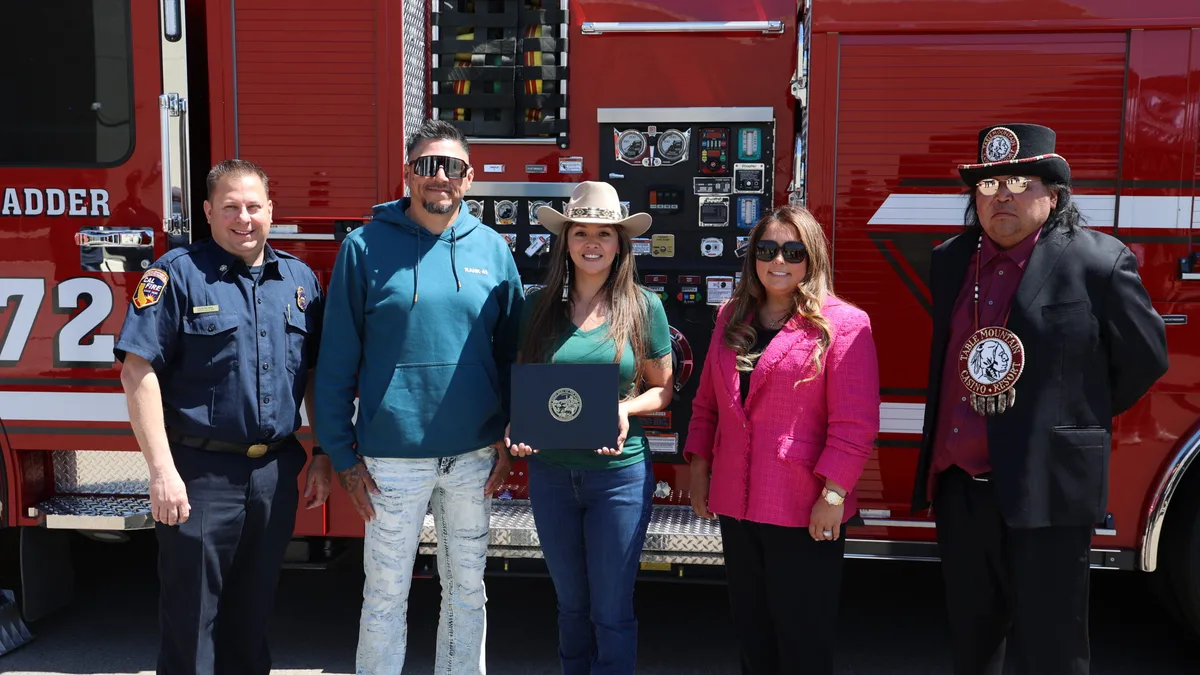
Community wildfire preparedness starts with neighbors sitting down together. The Firewise program gives that effort a formal framework.
Annual renewal is required to stay in good standing. That means logging your risk reduction hours, hosting your outreach event, and updating your action plan as conditions change. It is not a one-time certificate. It is an ongoing commitment.
Firewise Communities in the Bay Area
The Bay Area has some of the highest Firewise participation in the state. Marin County leads by a wide margin, largely thanks to Fire Safe Marin and the community organizing that followed the 1991 Oakland Hills fire and the growing awareness of WUI risk.
Marin County
70+ sitesKent Woodlands, Sleepy Hollow, Homestead Valley, Tam Valley, Muir Beach, Lucas Valley, and dozens more. Marin leads the Bay Area in Firewise recognition by a wide margin.
Contra Costa County
7+ sitesOrinda Wilder, Carroll Ranch (Moraga), Martinez, El Cerrito, and several Orinda neighborhoods including Dias Dorados and Campolindo Drive.
Sonoma County
3+ sitesBennett Ridge and Fountaingrove II in Santa Rosa, and Oakmont Village Association. All three formed after the devastating 2017 Tubbs Fire.
Santa Cruz County
Emerging sitesSeveral communities began the process after the 2020 CZU Lightning Complex. The mountain communities above Santa Cruz are actively pursuing recognition.
If your neighborhood is not on this list, that is not necessarily a problem. It means there is an opportunity to be the community that gets it started. We have worked with neighborhoods in the early stages of Firewise planning, and the biggest challenge is usually just getting the first few residents to commit. Once momentum builds, it tends to sustain itself.
Firewise Recognition and Insurance
This is where Firewise recognition goes from a nice community initiative to something with real financial impact. California law now ties wildfire mitigation directly to insurance pricing.
Insurance Benefits of Firewise Recognition
California law requires insurers to consider Firewise recognition when setting premiums under the Safer from Wildfires framework
Some carriers offer direct discounts of up to 5% to 20% for Firewise community residents
Firewise recognition may reduce the likelihood of non-renewal notices from your insurer
Your Firewise certificate can be submitted directly to your insurance company as proof of community-level mitigation
Businesses in Firewise communities may also qualify for commercial property insurance discounts
How This Connects to Home-Level Mitigation
Firewise recognition covers community-level mitigation. But California's Safer from Wildfires framework (Regulation 2644.9) also requires insurers to consider individual property improvements across 12 categories. The strongest insurance case combines both: your community has Firewise recognition, and your individual property has documented home hardening and defensible space compliance. That is where our home hardening documentation and exterior sprinkler systems come in. We help you build the property-level documentation that pairs with your community's Firewise status.
How FireRoofs Works With Firewise Communities
We work with individual homeowners, but we also work with neighborhoods. When a Firewise community is coordinating its risk reduction efforts, we can help at the property level with the mitigation measures that move the needle.
Property assessments
We evaluate individual homes against the mitigation categories under Regulation 2644.9 and document current conditions, completed upgrades, and code compliance.
Home hardening documentation
Detailed reports that cover your roof, vents, fencing, siding, decks, windows, and Zone 0 clearance. This documentation supports both your personal insurance case and your community Firewise action plan.
Exterior sprinkler systems
Automated systems that pre-wet your roof, eaves, and perimeter vegetation when conditions are dangerous. Adds an active defense layer on top of your structural hardening.
Community coordination
When multiple homes in a Firewise community schedule evaluations together, we can assess the neighborhood holistically and identify shared vulnerabilities that affect the whole community.
About This Page
This guide was written by the FireRoofs team. Our founders come from construction and landscaping backgrounds and live and work in the same high fire risk Bay Area communities where our clients live. We are not a national company writing about Firewise from a distance. We work in these neighborhoods, see these fire risks firsthand, and understand what it takes to get a community organized around wildfire preparedness.
Information on this page is sourced from the NFPA Firewise USA program, CAL FIRE, the California Department of Insurance, and our own experience working with Bay Area homeowners and communities. If you spot something that needs updating, let us know.
Start With Your Property
Whether your neighborhood is already Firewise or just getting started, the first step is understanding your own property. Let our team assess your home, document its condition, and help you build a defensible case for better insurance coverage.
Check Your Property's Wildfire Readiness
Whether your neighborhood is Firewise-certified or just getting started, the first step is knowing where your own home stands. Our satellite pre-assessment shows your roof, vegetation clearance, and fire zone.
- Quick satellite snapshot for your specific address
- Fire zone and defensible space overview
- Shareable report you can bring to community meetings
Takes about a minute. No account needed.