What Actually Burns Homes in a Wildfire
Before building a defense, it helps to understand what you are defending against. CAL FIRE and fire research institutions have documented three primary ignition pathways.
Flying embers are responsible for the majority of homes destroyed in wildfires. They travel miles ahead of the fire front, landing on roofs, in gutters, against siding, and in vents. A single ember is enough.
Radiant heat can shatter windows and ignite wood siding from a burning structure across the street, before any flame has touched your home.
Direct flame contact is the final stage. By the time flame reaches your structure, the outcome has usually already been decided.
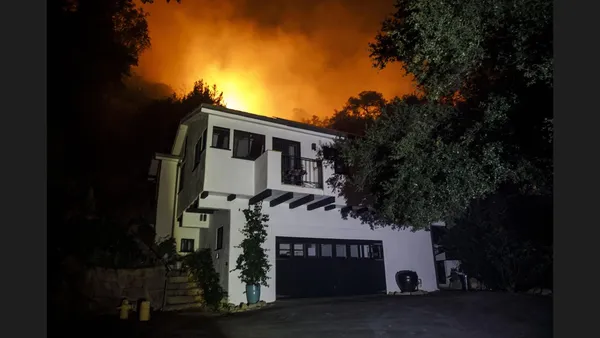
The January 2025 Palisades Fire in Los Angeles County demonstrated exactly how compressed this timeline is. An estimated 85% of destroyed structures were lost in the first 60 to 90 minutes, before fire crews could reach most homes. A complete defense strategy addresses all three ignition pathways before the fire arrives.
Passive Home Hardening
Passive hardening means building or retrofitting your home with materials that resist ignition. These changes do not require active monitoring or automation. They simply make the structure itself harder to ignite.
Roof
Your roof is the largest and most exposed surface during an ember attack. Roofs with wood shakes, missing tiles, or gaps along the ridge line create landing zones where embers settle, smolder, and ignite. A Class A fire-rated roof is the single most effective passive hardening upgrade available. CAL FIRE recommends Class A roofing for all homes in high-risk zones. See the CAL FIRE home hardening guide. In California, tile, metal, and composition shingles rated Class A are the minimum standard for new construction in Very High Fire Hazard Severity Zones.
Gutters and Eaves
Gutters filled with dry leaves and pine needles are ready-made ember fuel. Noncombustible gutter guards reduce accumulation. Regular cleaning before fire season is essential regardless. Eave soffits should be enclosed with ignition-resistant materials to eliminate the gap where embers enter and accumulate against the structure. FireRoofs specifies surgical-grade stainless steel micro-mesh gutter guards and encloses open eaves with fiber cement soffit panels, installed by our vetted, licensed and insured partner contractors. See our Home Hardening Products Guide for the specific products we use.
Vents
Attic vents, soffit vents, and foundation vents are direct pathways into the structure. One-eighth inch wire mesh screens block ember entry without restricting airflow. Ember-resistant vent covers are available as a retrofit and are required under California’s WUI building code for new construction in high-risk zones. This is one of the least expensive and highest-impact passive hardening steps available. FireRoofs installs Vulcan Vents, which are ASTM E2886 certified and listed by the California State Fire Marshal. See rated vent products in our Home Hardening Products Guide.
Windows and Doors
Radiant heat causes single-pane windows to fail before flames arrive. Dual-pane windows with tempered glass significantly increase resistance. Exterior doors should be solid-core with fire-resistant weatherstripping and thresholds that block ember infiltration under the door.
Siding and Walls
Vinyl siding melts under radiant heat. Wood siding provides ember fuel. The most resilient materials for WUI homes are three-coat stucco, fiber cement siding, and metal siding. These materials dramatically reduce the surface area available for ignition. Browse Fire Marshal-listed siding products to compare ratings and costs.
Fencing
Wood fences connected directly to a home create a continuous flame path from the perimeter to the structure. This is one of the most overlooked vulnerabilities in WUI properties. Noncombustible fencing that breaks the fence-to-structure connection eliminates this pathway entirely.
Defensible Space
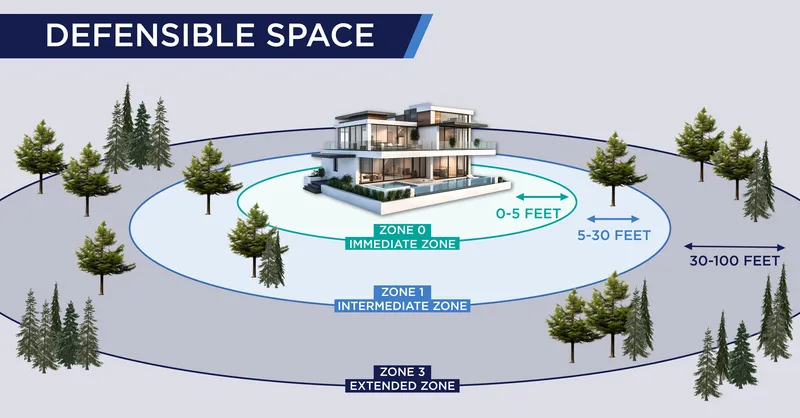
Defensible space is the managed area around your home that slows fire spread and reduces the fuel load available to feed flames toward your structure. California law requires defensible space for homes in State Responsibility Areas.
Zone Zero (0 to 5 feet)
Zone Zero is the five-foot perimeter directly around your home. This is the highest-priority zone because it is where embers accumulate and where the fire-to-structure transition most commonly occurs. The statewide Zone Zero standard, which calls for removing combustible material such as mulch, wood chip ground cover, dead plants, and firewood from this five-foot band, is still in draft with the California Board of Forestry, with a final draft considered in August 2026. Some local jurisdictions, including the City of Berkeley and the Moraga-Orinda Fire District, already enforce a five-foot noncombustible zone.
Zone 1 (5 to 30 feet)
In Zone 1, the goal is to reduce continuity between fuel sources. Trees should be spaced so their canopies do not touch. Lower branches should be limbed up to keep ground fire from climbing into the tree canopy. Shrubs should be grouped with spacing between clusters.
Zone 2 (30 to 100 feet)
Zone 2 focuses on overall fuel reduction. Maintaining grass at a low height, removing dead vegetation, and thinning tree density all reduce the rate at which a fire approaching your structure gains intensity.
CAL FIRE’s Ready for Wildfire program provides the official defensible space guidelines for California homeowners, including requirements by property slope.
Active Wildfire Defense
Passive hardening and defensible space reduce ignition risk. They do not eliminate it. In a severe wildfire event with high winds and sustained ember attack, a hardened home with clear defensible space can still ignite. The third layer is active defense: an automated exterior fire sprinkler system that detects wildfire threats and responds before the fire arrives.
An exterior wildfire defense system monitors for wildfire threats around the clock and activates roof, eave, and perimeter sprinklers automatically when a confirmed threat is detected. The system saturates every surface fire would target: the roof surface, the eave line, the perimeter vegetation zone. It activates even when you are not home, even when you have evacuated, and even when visibility is zero.
In the 2007 Ham Lake Fire in Minnesota, all 188 properties equipped with exterior sprinkler systems survived. Neighboring unprotected structures did not. See the full evidence from real fires.
FireRoofs exterior defense systems are designed for each property and installed by vetted, licensed and insured partner contractors with decades of experience in irrigation design and water systems. See our service tiers for full details.
Service Tiers
Keystone
Roof sprinklers, smart controller, satellite monitoring automation. Essential roof defense for properties in elevated-risk zones.
Guardian, Most Popular
Adds eave sprinklers and dual wildfire detection with on-property cameras. Designed for hilltop estates and multi-structure properties.
Fortress
Adds automated Class A foam injection at the highest threat level. Class A foam is the same formulation used by wildland fire agencies. It is 100% biodegradable, non-toxic to plants, pets, and wildlife, and rinses off through the sprinklers following an event. Maximum protection for properties in Very High Fire Hazard Severity Zones.
Add-ons available for any tier: pool water supply connection, dedicated water storage tank, booster pump for low-pressure properties, and perimeter ground sprinklers. See full service details for more.
Wildfire Detection: Why It Decides Everything
The most critical design decision in any automated wildfire defense system is when it activates. Activate too early, at a fire six or seven miles away, and the system burns through the water supply long before any real threat reaches the structure. By the time the fire closes to within a mile, the sprinklers have already run dry.
This is why detection architecture matters more than any other single variable in system design.
FireRoofs uses dual wildfire detection: two independent systems working together to confirm threats before the system escalates.
Layer 1 is regional satellite wildfire monitoring, pulling from GOES-18, NOAA, and CAL FIRE data feeds within a five-mile radius of the property. This layer pre-arms the system when wildfire activity is detected in the surrounding region.
Layer 2 is on-property cameras with intelligent fire detection and sensors. This layer confirms that a genuine, proximate threat is approaching the specific property before the smart controller escalates to an active defense response.
The two layers cross-reference what they detect to reduce false alarms and catch real threats faster. If the cameras detect a threat at the property before satellite picks up regional activity, the system responds immediately without waiting for cross-confirmation. The result is a system that does not exhaust your water supply on a fire seven miles away. It reserves it for the threat that is actually coming toward your home.
Full detection specifications are available in our technical specifications.
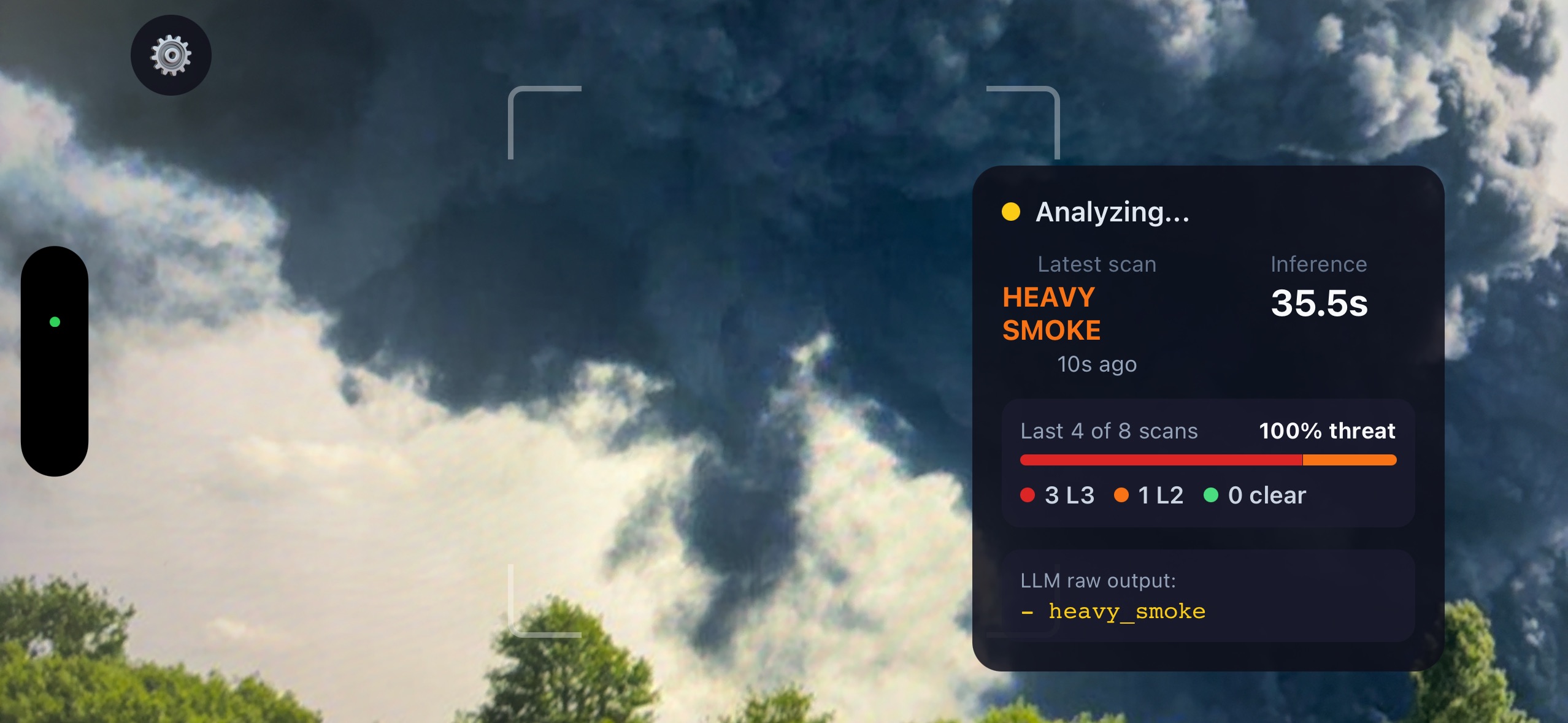
The Three-Level Threat Response
When dual detection confirms a threat, the system escalates through three levels, with each level triggering proportional defensive action. The homeowner receives push notifications at each stage and retains a cancel window throughout. Manual activation is also available from anywhere via the FireRoofs app.
Water Supply Planning
An exterior defense system is only as good as its water supply. For properties in WUI communities, water supply planning is a critical design variable, not an afterthought.
Minimum 60 PSI is required for effective sprinkler coverage. Properties on steep lots or with long pipe runs may need a booster pump to maintain consistent pressure across all zones.
The January 2025 Palisades Fire demonstrated exactly why independent water supply matters. Municipal water infrastructure collapsed under demand during that event, leaving homes without any fire suppression capability at the worst possible moment.
For properties with a swimming pool, connecting the pool as an independent backup water source significantly extends operational capacity. A standard 18,000-gallon pool provides approximately 12 hours of continuous system operation. The switchover is automatic and requires no manual intervention. A recent FireRoofs Fortress installation in Saratoga included this configuration on a pool-integrated system covering 6,000 square feet of roof surface across an 8,900-square-foot estate.
For properties without a pool, a dedicated water storage tank sized to system flow requirements provides the same independent supply capability. Tank sizing is determined during the property evaluation based on zone count and expected flow rates.
The system requires electrical power. FireRoofs strongly recommends a backup generator as the primary power solution. A generator provides the sustained wattage needed to run booster pumps, the smart controller, cameras, and connectivity simultaneously for extended periods.
Ready to See What Your Property Needs?
Every property out here is different. We’ll walk yours for free and tell you exactly what it needs.
Book Free Home EvaluationInsurance and the WUI Crisis
California’s insurance market for WUI properties is under severe stress. Major carriers have withdrawn from high-risk zip codes across the state. Homeowners in Saratoga, Woodside, Los Gatos, and dozens of other Bay Area communities are being forced onto the FAIR Plan, the state’s insurer of last resort.
The FAIR Plan caps coverage at $3 million. Properties in these communities routinely have rebuild costs of $5 million to $15 million or more. The gap is not covered.
Documented wildfire mitigation, including a professionally installed exterior defense system, is increasingly factored into insurance underwriting and coverage decisions. One 2026 California law is directly relevant.
SB 429 (Wildfire Public Catastrophe Model): Establishes a public wildfire risk model that provides greater transparency into how properties are scored for insurance purposes.
Full regulatory details and insurance strategy guidance on our insurance and WUI page.
California Regulations: Zone Zero and SB 429
California’s statewide Zone 0 rule, which would require the five-foot perimeter immediately surrounding a home to be free of combustible materials in State Responsibility Areas and High and Very High Fire Hazard Severity Zones, is still in draft with the Board of Forestry (final draft considered August 19, 2026), with a phased rollout planned. Some local jurisdictions already enforce a five-foot noncombustible zone, and local ordinances vary by city. For example, Saratoga’s updated tree ordinance effective March 6, 2026 now allows removal of trees within five feet of a home citywide for wildfire risk reduction, with free permits for dead trees, Monterey pine, and blue gum eucalyptus in WUI zones. Woodside offers a $3,000 Defensible Space and Home Hardening Matching Fund alongside a free chipper program running May through November.
SB 429, effective January 1, 2026, requires the development of a public wildfire catastrophe model, giving homeowners and regulators greater visibility into wildfire risk scoring methodology used by insurers.
The California Fire Safe Council provides community-level resources, grant program information, and local fire safe council contacts for Bay Area homeowners. Visit cafiresafecouncil.org.
Bay Area Risk by Community
Not all fire risk is equal, and not all properties within a community carry the same exposure. CAL FIRE’s Fire Hazard Severity Zone maps are the official source for property-level designation. Local conditions, topography, wind patterns, and vegetation density all affect actual risk at the property level.
Very High Fire Hazard Severity Zones served by FireRoofs: Saratoga, Los Gatos, Monte Sereno, Woodside, Emerald Hills, Portola Valley, Los Altos Hills, Stanford/Skyline corridor, East Bay Hills, Santa Cruz Mountains communities.
High Fire Hazard Severity Zones served by FireRoofs: Scotts Valley, Aptos, Soquel, Danville, Pleasanton, Livermore, Morgan Hill, Redwood City, San Jose hillside communities, Fremont hillside areas, San Ramon, Alamo, Dublin, Hayward, Castro Valley, Atherton, Menlo Park.
FireRoofs serves communities across the Bay Area and Santa Cruz Mountains, spanning Santa Clara, San Mateo, Santa Cruz, Alameda, and Contra Costa Counties.
Check your property’s wildfire risk designation and fire history on our wildfire risk hub.

Free AI Assistant
HydroIQ by FireRoofs
Get Instant Answers About Your City’s Wildfire Rules
Every Bay Area city has its own wildfire ordinances, defensible space rules, tree permit requirements, fire district programs, and insurance considerations. Until now, finding that city-specific detail meant navigating a dozen different government websites alone.
HydroIQ is a free AI wildfire assistant built by FireRoofs that answers your specific wildfire questions with city-level, regulation-level, and jurisdiction-level detail. No app to download. No login to create. No cost to use.
HydroIQ covers communities across the Bay Area, not just the cities FireRoofs serves. It can answer questions like:
- “Can I remove this tree for wildfire safety in Saratoga?”
- “What are my defensible space requirements in Woodside?”
- “How does the FAIR Plan cap affect my property in Los Altos Hills?”
- “What defensible space rules apply in my city?”
- “What is Zone Zero and what do I need to remove?”
- “How does dual wildfire detection actually work?”
HydroIQ is available now on every page of fireroofs.com. Look for the chat banner at the top of the page. It is also prominently embedded on the wildfire risk hub, where suggested questions are tailored to the city page you are reading. Voice input is supported. You can also upload property photos or documents for more personalized guidance, which the FireRoofs team reviews within one to two business days.
HydroIQ does not replace evacuation. If you have an active fire emergency, call 911 immediately.
Where to Start
A complete wildfire defense strategy combines all three layers: passive hardening that reduces ignition vulnerability, defensible space that slows fire spread, and an active automated system that defends when it matters most.
If you have city-specific questions about defensible space rules, tree permits, local ordinances, or how a defense system fits your specific property, start with HydroIQ at fireroofs.com. Free, instant, and specific to your community.
If you are ready to understand what an installed system looks like for your property, a no-cost evaluation is the right next step. FireRoofs walks your property, tests water pressure, inspects the roof and eave lines, and delivers a full proposal within one to three business days.
Book your free evaluation on our evaluation page or call (831) 705-0888.
Frequently asked questions
What is a wildfire defense system?
A wildfire defense system combines three layers of protection: passive home hardening, defensible space, and an automated exterior sprinkler system that pre-wets the roof, eaves, and landscape as a fire approaches. FireRoofs designs and coordinates these systems, and installation is completed by vetted, licensed and insured partner contractors.
Do exterior sprinklers actually protect a home from wildfire?
Exterior sprinklers raise moisture on and around the structure so wind-blown embers are far less likely to ignite it. They are one layer of defense, most effective when combined with a hardened structure and maintained defensible space, and they depend on an adequate water supply and power.
How much does home wildfire protection cost?
Cost depends on roof size, water source, site access, and how many layers you add. Passive hardening and defensible space can be phased in over time, while an automated exterior system is a larger investment. See our cost guide and estimator for typical ranges for Bay Area properties.
What does California law require for home wildfire protection?
California requires defensible space under Public Resources Code 4291 and ember-resistant construction under Building Code Chapter 7A for homes in designated Fire Hazard Severity Zones. A statewide Zone 0 rule requiring a 5 foot noncombustible zone is still in draft with the California Board of Forestry, with a final draft considered in August 2026. Source: bof.fire.ca.gov.
Where should Bay Area homeowners start?
Start by confirming your Fire Hazard Severity Zone and your local defensible space rules, then harden the most exposed parts of the structure first: the roof, vents, and the first 5 feet. A free on-site evaluation can identify the highest-impact steps for your specific property.
External Resources

Have a question? Ask HydroIQ
HydroIQ is FireRoofs' free AI wildfire assistant. Get instant answers about wildfire risk, defensible space rules, insurance options, and fire defense systems.
Reviewed by Shawn Gardner and Walt Mullins. Last updated August 2026. All work is performed by licensed and insured contractors.