FireRoofs Wildfire Defense, Bay Area exterior sprinkler systems
Back to Blog

What Does California Law Require for Home Hardening in 2026?

FireRoofs Team

Written by the FireRoofs Team

April 28, 2026·12 min read·Home Hardening
What Does California Law Require for Home Hardening in 2026?

California's wildfire laws moved fast in 2025 and kept moving. Three new state laws took effect January 1, 2026, and Zone Zero compliance deadlines are now closer than most Bay Area homeowners have been told. Between updated disclosure requirements at the point of sale, active grant money available for hardening upgrades, and state-mandated insurance discounts tied to specific improvements, the question is no longer whether to harden your home. In California's fire-prone communities, the question is whether what you have already done meets the current standard, and what the deadline is for the rest.

What California Law Currently Requires

Assembly Bill 38: Disclosure at Point of Sale

Assembly Bill 38 (AB 38) took effect January 1, 2021, and applies to homes built before 2010 in Very High Fire Hazard Severity Zones (VHFHSZ). When selling, owners must complete the California Association of Realtors' Fire Hardening and Defensible Space Advisory, Disclosure, and Addendum (FHDS form), documenting whether the home has fire-resistant roofing, enclosed eaves, ember-resistant vents, and dual-pane or tempered glass windows. This is a disclosure, not a mandatory retrofit. But buyers are paying close attention, and lenders are beginning to as well. Homes with no hardening documentation are increasingly difficult to insure and sell. Source: AB 38 / CA Association of Realtors

AB 888: The California Safe Homes Act (Effective January 1, 2026)

The California Safe Homes Act went into effect January 1, 2026. It establishes a new grant program at the California Department of Insurance to help qualifying homeowners pay for home hardening work, specifically fire-safe roofing and Zone Zero mitigation within the first five feet of the structure. These are among the highest-impact but most expensive improvements homeowners face. The grant program is designed to cover part or all of the costs and is linked to community-wide safety initiatives. If you are in a qualifying area and have been delaying Zone Zero compliance because of cost, this program exists specifically for that situation. Source: California Department of Insurance

Zone Zero: The 5-Foot Ember-Resistant Zone

AB 3074 (2020) and SB 504 (2024) directed California's Board of Forestry and Fire Protection to formally define Zone Zero: the first five feet immediately surrounding any structure. Governor Newsom's Executive Order N-18-25, signed in February 2025 following the Los Angeles fires, ordered the Board to finalize these rules by December 31, 2025. For new construction, the rules apply immediately upon adoption. The compliance timeline is no longer theoretical: existing homes in Very High Fire Hazard Severity Zones must comply by January 1, 2027.

Diagram showing California defensible space Zone Zero (0-5 ft), Zone 1 (5-30 ft), and Zone 2 (30-100 ft) around a home
California's three defensible space zones under PRC 4291 and the Zone Zero regulations now taking effect.

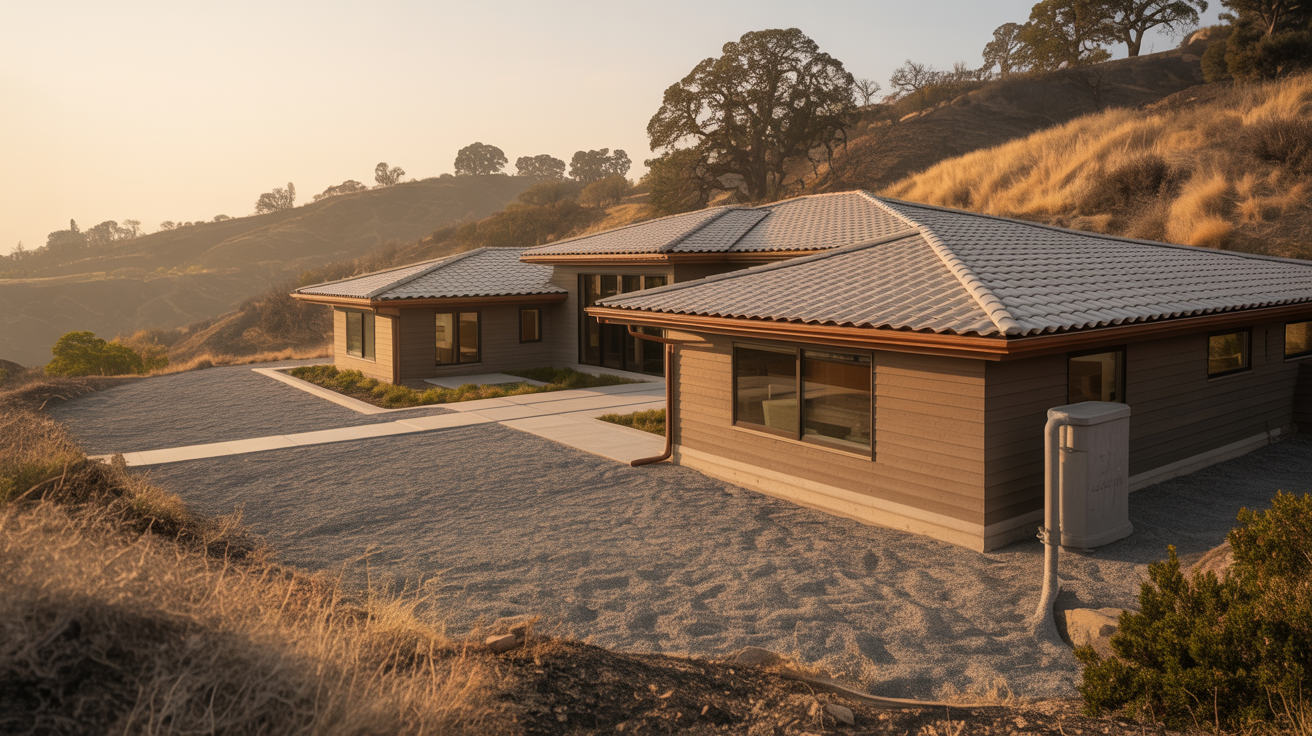
What Zone Zero prohibits: combustible mulch, wood-based bark, wooden fences or gates attached to the structure, dry vegetation, and stored lumber within five feet of any wall, deck, or stairway. What is permitted: gravel, pavers, concrete, and a limited number of potted plants in non-combustible containers no taller than 18 inches. Source: CA Board of Forestry and Fire Protection

See how FireRoofs approaches Zone Zero compliance for WUI properties.

SB 429: The Wildfire Public Model Act (Effective January 1, 2026)

Senate Bill 429 took effect January 1, 2026, and establishes the nation's first publicly available wildfire loss catastrophe model through the California Department of Insurance. For the first time, homeowners, communities, and local governments can access the same risk modeling data that insurers use to set rates and make coverage decisions. This is a transparency tool, not a personal risk score, but it gives Bay Area homeowners better data to understand where their property sits relative to the broader wildfire risk landscape. Source: California Wildfire and Forest Resilience Task Force

Chapter 7A Building Code: New and Rebuilt Structures

Any home built or significantly rebuilt in a State Responsibility Area or Very High Fire Hazard Severity Zone after 2008 must meet Chapter 7A of the California Building Code. This includes ignition-resistant siding materials, enclosed eaves, ember-resistant vents (1/16-inch mesh maximum), and dual-pane or tempered glass windows. If you are remodeling or adding square footage, those sections of your home must be brought into Chapter 7A compliance.

Defensible Space: Still Law, Still Inspected

California Public Resources Code 4291 requires 100 feet of defensible space around structures in state responsibility areas. Zone 1 (5 to 30 feet) must be lean, clean, and green: no dead vegetation, limbs pruned up six feet from the ground, no ladder fuels. Zone 2 (30 to 100 feet) requires reduced fuel loads and spacing between plants and trees. Cal Fire conducts inspections, and AB 38 requires that defensible space compliance be documented at the time of sale. Source: CAL FIRE

Read our full guide to defensible space requirements and how they interact with active wildfire defense.

What Home Hardening Actually Looks Like: Room by Room, Zone by Zone

The Roof

A Class A fire-rated roof is the single highest-value upgrade a California homeowner can make. Class A materials, which include concrete tile, metal roofing, and Class A-rated composition shingles, are the most fire-resistant category under ASTM E108 testing standards. Insurers recognize this: Class A roofing consistently produces the largest Safer from Wildfires discount, typically ranging from 8 to 15 percent off annual premiums. Source: California Insurance Code Section 2644.9

Gutters deserve equal attention. Metal gutter guards that block debris accumulation prevent dry leaf and needle buildup from turning into an ember catch during a fire event. Uncovered gutters full of dry debris are one of the most common ignition points documented in post-fire investigations.

Vents and Eaves

Open eave vents and attic vents are direct pathways for embers into the structure. Chapter 7A requires 1/16-inch mesh screens on all vent openings. Aftermarket ember-resistant vent covers that meet ASTM E2886 testing standards are available for existing homes and are explicitly recognized under California's Safer from Wildfires insurance discount framework. Enclosed eaves, where the underside of the eave overhang is fully sheathed with a non-combustible material, eliminate the open-cavity ignition point entirely.

Windows and Doors

Dual-pane windows with tempered glass are required under Chapter 7A and recognized under AB 38 disclosure. Single-pane windows fail rapidly under radiant heat exposure. Tempered glass holds significantly longer, buying time before interior ignition. In locations with extreme radiant heat exposure, multi-pane windows or deployable non-combustible shutters offer additional protection. Source: Insurance.com

Siding and Exterior Walls

Fiber cement siding, such as products in the Hardie board family, is a widely used ignition-resistant alternative to wood or vinyl siding. It does not ignite, does not melt, and holds its structural integrity under radiant heat exposure. Stucco is another non-combustible option that meets Chapter 7A standards. Replacing wood or vinyl lap siding on WUI homes is one of the most impactful structural upgrades available, particularly on gable ends and walls facing likely fire approach paths. Source: CAL FIRE Home Hardening

Decks and Patios

Wood decks are a documented ignition point. Composite decking materials that meet ignition-resistant standards, combined with enclosed deck skirting to eliminate the void beneath the deck, substantially reduce this vulnerability. Under Zone Zero regulations, combustible materials stored beneath or adjacent to decks will be prohibited. Non-combustible pavers, concrete, or decomposed granite at the deck perimeter are compliant materials.

Fencing

Wooden fencing attached to or running up to the structure creates a direct flame path from the vegetation zone directly to the home. Zone Zero regulations are expected to require removal or replacement of wooden fences within five feet of any structure. Non-combustible fencing options, including steel, aluminum, and concrete block, eliminate this ignition pathway entirely while maintaining the look and function of a property boundary. This upgrade is Zone Zero compliant by design.

What Hardening Alone Does Not Cover

Home hardening improves your home's resistance to ember intrusion, radiant heat, and short-duration flame contact. What it does not do is actively defend the structure when fire arrives. A hardened but unattended home still depends on conditions holding: no ember accumulation in a missed gutter, no wind shift that puts a flame front directly against the structure, no water pressure loss in the municipal system during a major fire event.

That is the gap that exterior wildfire defense systems fill. FireRoofs installs automated roof, eave, and perimeter sprinkler systems that activate when wildfire is detected within five miles, saturating the structure and creating a moisture barrier across every ignition-vulnerable surface. The system operates whether you are home or not, and is designed to function alongside your hardening upgrades, not as a substitute for them.

Under California Insurance Code Section 2644.9, the Safer from Wildfires framework, documented mitigation measures including exterior sprinkler systems can qualify homeowners for insurance premium discounts of 10 to 20 percent. FireRoofs provides the documentation homeowners need to submit these claims. Source: Fireroofs.com Insurance and WUI

Your 2026 Home Hardening Action List

  1. Confirm your Fire Hazard Severity Zone designation at the CAL FIRE FHSZ mapping tool. Your zone determines your compliance deadlines.
  2. If you are in a Very High FHSZ, your Zone Zero compliance deadline is January 1, 2027. Start now.
  3. Check eligibility for AB 888 grant funds to offset the cost of roofing and Zone Zero work through the California Department of Insurance.
  4. Replace or screen all roof and attic vents with ASTM E2886-compliant ember-resistant covers.
  5. Install metal gutter guards on all gutters and clean them at the start of each fire season.
  6. Clear Zone Zero: remove all combustible mulch, wood debris, stored materials, and flammable vegetation within five feet of your home, decks, and stairs. Replace with gravel, pavers, or concrete.
  7. Replace single-pane windows with dual-pane tempered glass where budget allows, starting on south and west-facing walls.
  8. Evaluate exterior siding: if wood or vinyl, obtain quotes for fiber cement replacement, starting with gable ends and walls facing the wildland interface.
  9. Replace any wooden fencing attached to or running up to the structure with a non-combustible alternative.
  10. Maintain 100 feet of compliant defensible space per PRC 4291, with Zone 1 limbed up and cleared of dead material.
  11. Complete the AB 38 FHDS disclosure form if you are preparing to sell, and document every upgrade with receipts, photos, and contractor records.
  12. Request a wildfire defense evaluation to understand where active suppression fits into your overall protection plan. Book here.

Sources

Written by the FireRoofs Team. FireRoofs designs and installs automated wildfire defense systems for Bay Area WUI homes. Our systems combine dual wildfire detection, roof and eave sprinklers, and perimeter defense to protect structures before, during, and after a wildfire event. For questions or to schedule a property evaluation, call 831-705-0888 or email [email protected].

Ready to Protect Your Home?

Every property out here is different. We'll walk yours for free and tell you exactly what it needs.

Book Free Home Evaluation