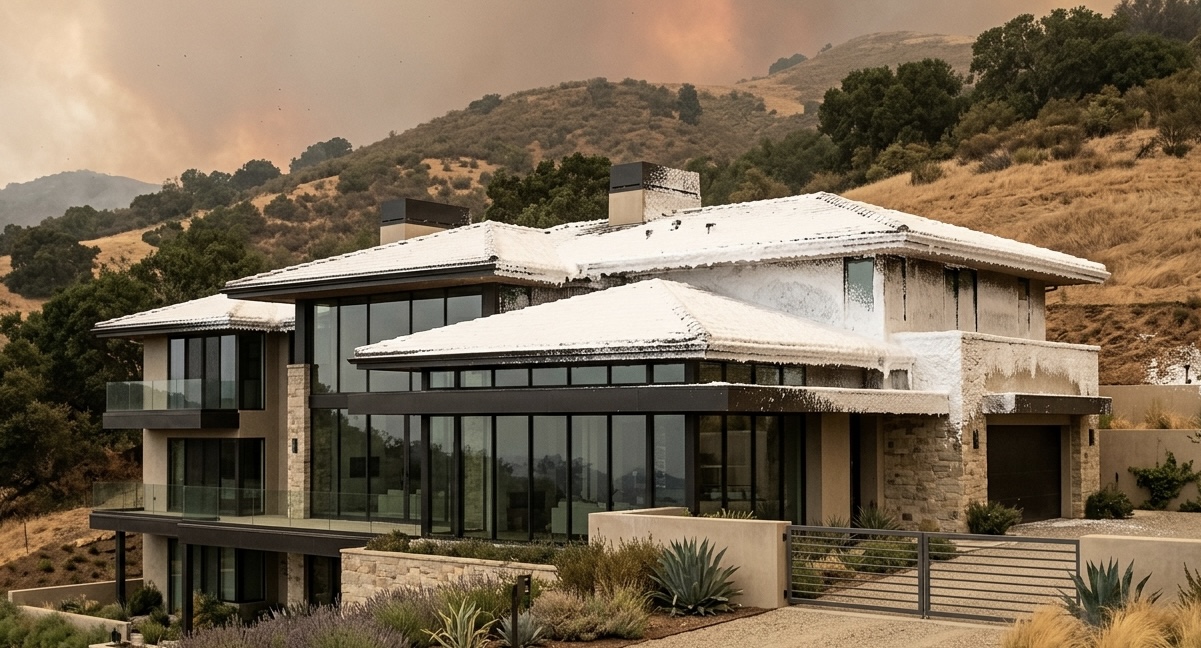
Most homeowners I talk to have seen footage of fire crews spraying foam on structures. Big hoses. Trucks everywhere. Crews on the roof. It looks like a last-ditch effort because that's usually exactly what it is.
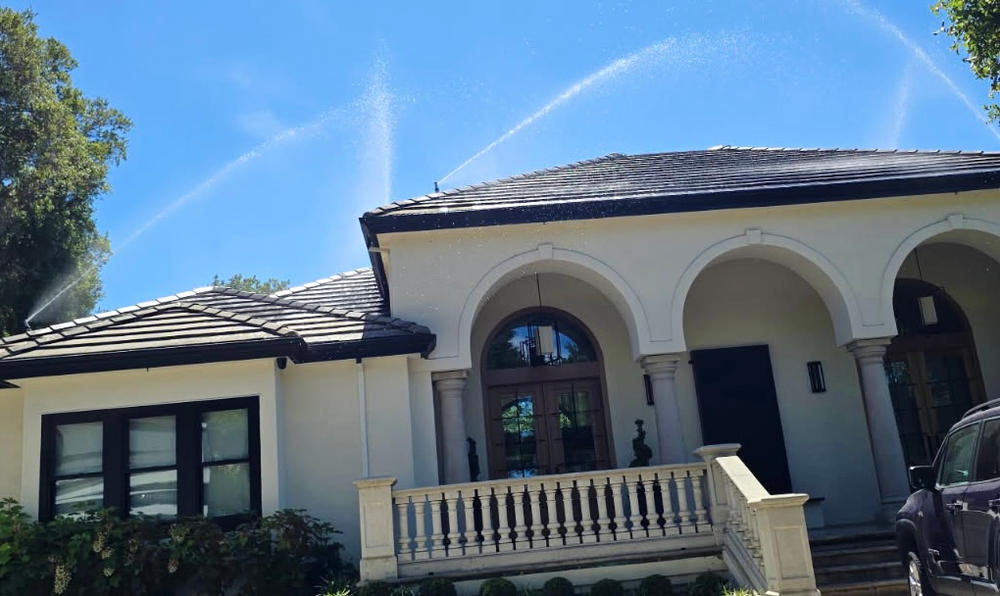
What they haven't seen is what it looks like when foam deploys automatically. No crew. No truck. There was no one present on the property at all. The system detects a threat, escalates through its response levels, and at the highest level, foam starts flowing through the same sprinkler heads that were already saturating the roof with water.
That's how Class A foam application works in an automated wildfire defense system. And it changes how long your home can resist fire without anyone there to help.
What Class A Foam Actually Is
Class A foam is a concentrate mixed into water that dramatically increases the water's ability to penetrate, cling, and insulate surfaces. It's the same formulation used by wildland fire agencies across the country. CAL FIRE has used it on major incidents, including the Ranch, Tubbs, and Camp fires.
Here's the thing about water by itself. It runs off. You spray a roof with water, and within minutes, the surface is drying. Embers can land on a drying roof and find enough heat to ignite. Water buys time, but it doesn't hold.
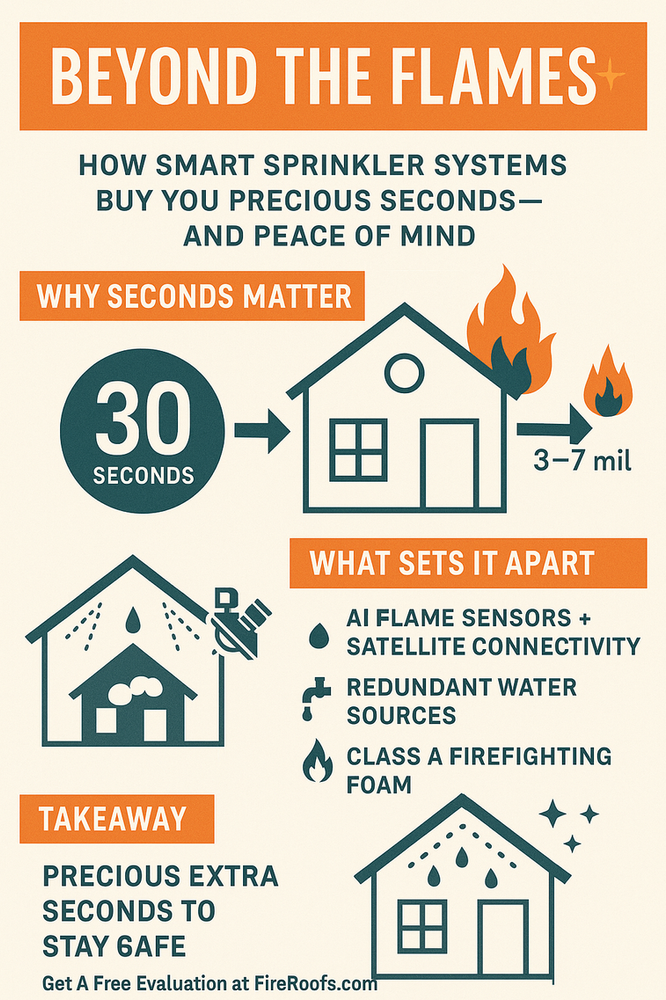
Foam changes that equation. When Class A foam is mixed into the roof sprinkler water, it creates a blanket that sticks to surfaces three to five times longer than water alone. It clings to roof tiles, coats eave soffits, and wraps around siding. That blanket holds moisture against the surface and creates an insulating barrier between the material and the heat trying to ignite it.
It's not magic. But the difference between a wet surface and a foam-coated surface during a 90-minute ember storm is significant.
How Foam Deploys in a FireRoofs System
In our three-tier service structure, Class A foam is included in the Fortress tier and available as an add-on for Sentinel and Guardian systems. Either way, the mechanics work the same.
The system runs through three automated threat levels. At Level 1, satellite monitoring detects fire activity in the region, and the system begins pre-wetting your roof, eaves, and perimeter with water. At Level 2, the threat has moved closer or conditions are escalating. Watering frequency increases across all zones, and the system automatically switches to your backup water source if municipal pressure drops.
Level 3 is where foam comes in.
When the system reaches maximum threat, the foam proportioning system activates. Concentrate is drawn from a dedicated tank and mixed into the water supply at a precise ratio. The foam-water mixture then flows through the same roof and eave sprinkler heads that were already running. No separate equipment. No manual valves. The transition from water to foam happens automatically.
The foam covers your roof surface, eave line, siding, and any exposed surfaces within the sprinkler zones. It builds up in layers as the system cycles. Each pass adds more insulation. You can see the full technical specs for the proportioning system, but the main point is that you don't have to do anything. The system handles the mixing, the timing, and the application.
What It Looks Like on Your Property
I'll be direct about this because it matters. When foam is active, your home looks like it's covered in thick white foam. It's not subtle. From the street, it appears that something dramatic is happening, and indeed, something dramatic is occurring. Your house is defending itself.
The foam coats the roof from ridge to eave. It fills valleys and corners where embers tend to collect. It wraps around window frames and covers the soffit line, which is the most common ember entry point on any home. On properties where perimeter sprinklers are also running, the ground-level vegetation zone is saturated with water while the structure above is coated in foam.
That layered approach matters. According to the Insurance Institute for Business & Home Safety, ember ignition is the primary cause of home loss in wildland fires. Between 60 and 90 percent of homes that burn in wildfires ignite from embers, not direct flame contact, per data from the California Office of the State Fire Marshal. Foam on the structure handles the surface ignition risk. Water on the vegetation handles the fuel around it.
Our Scotts Valley Fortress installation is a good example of what a full foam deployment looks like on a real property. That system includes roof-to-ground coverage with Class A foam, a backup water tank with automatic switchover, and dual wildfire detection with Starlink communication.
After the Threat: The Rinse Cycle
This is where homeowners usually have the most questions. What happens to the foam after the fire passes?
The answer is simple. Once the threat level drops back to zero, the system enters an automated rinse cycle. Water flows through the same sprinkler heads and washes the foam off every surface it covered. Class A foam is 100% biodegradable. It's non-toxic to plants, pets, and wildlife. It rinses clean from hardscape and will not damage ornamental plantings, specimen trees, or high-value landscaping.
No hazmat crew. No manual cleanup. No residue. Your property returns to normal within minutes of the rinse cycle completing.
I mention the landscaping specifically because that's a real concern for the properties we work on. A homeowner in Saratoga with $200,000 in mature landscaping needs to know that the system protecting their home won't destroy their property in the process. It won't.
Is Foam Right for Your Property?
To be frank, not every property needs it.
Foam is always optional in a FireRoofs system. For many homeowners, a Guardian-tier system with dual wildfire detection and water-based sprinkler coverage across roof, eaves, and perimeter is more than sufficient. Water alone, applied early and continuously, is highly effective against ember exposure.
Foam makes the most sense in a few specific situations. If your property has limited water supply and you need maximum protection per gallon, foam stretches your water further because it holds moisture longer. If your home is in a particularly exposed position, ridgeline, south-facing slope, or heavy fuel load on multiple sides, foam adds an extra margin that water alone may not provide. And if you simply want the highest level of protection available, the Fortress tier with foam is the most comprehensive system we build.
It depends on the property. It depends on the terrain. That's why every system starts with a free property evaluation where we walk your lot and assess what level of protection actually fits.
The 90-Minute Window
The January 2025 Palisades Fire proved what fire scientists have warned about for years. When a wildfire hits, the destruction happens fast. 85% of structures were lost in the first 60 to 90 minutes, before fire crews could reach most homes. Municipal water infrastructure collapsed under demand. Homes that could have been saved had no water pressure to fight with.
That's the window Class A foam application is designed for. Not when crews arrive. Not when the fire is under control. During the minutes when your home is on its own and nobody is coming.
None of this guarantees your home survives every fire. No system can promise that. But foam on the roof, water on the perimeter, and a detection system that triggers all of it before you even know there's a threat. That shifts the odds. And when embers are landing on your roof, that shift matters.
While exterior wildfire defense systems have proven effective in multiple real-world scenarios, no system can guarantee 100% protection against all wildfire conditions. Effectiveness depends on proper installation, maintenance, adequate water supply, and appropriate activation timing.
Book a free property evaluation to see whether foam makes sense for your home. Or call us at 831-705-0888.
Not ready to talk yet? Check your property's wildfire risk first.